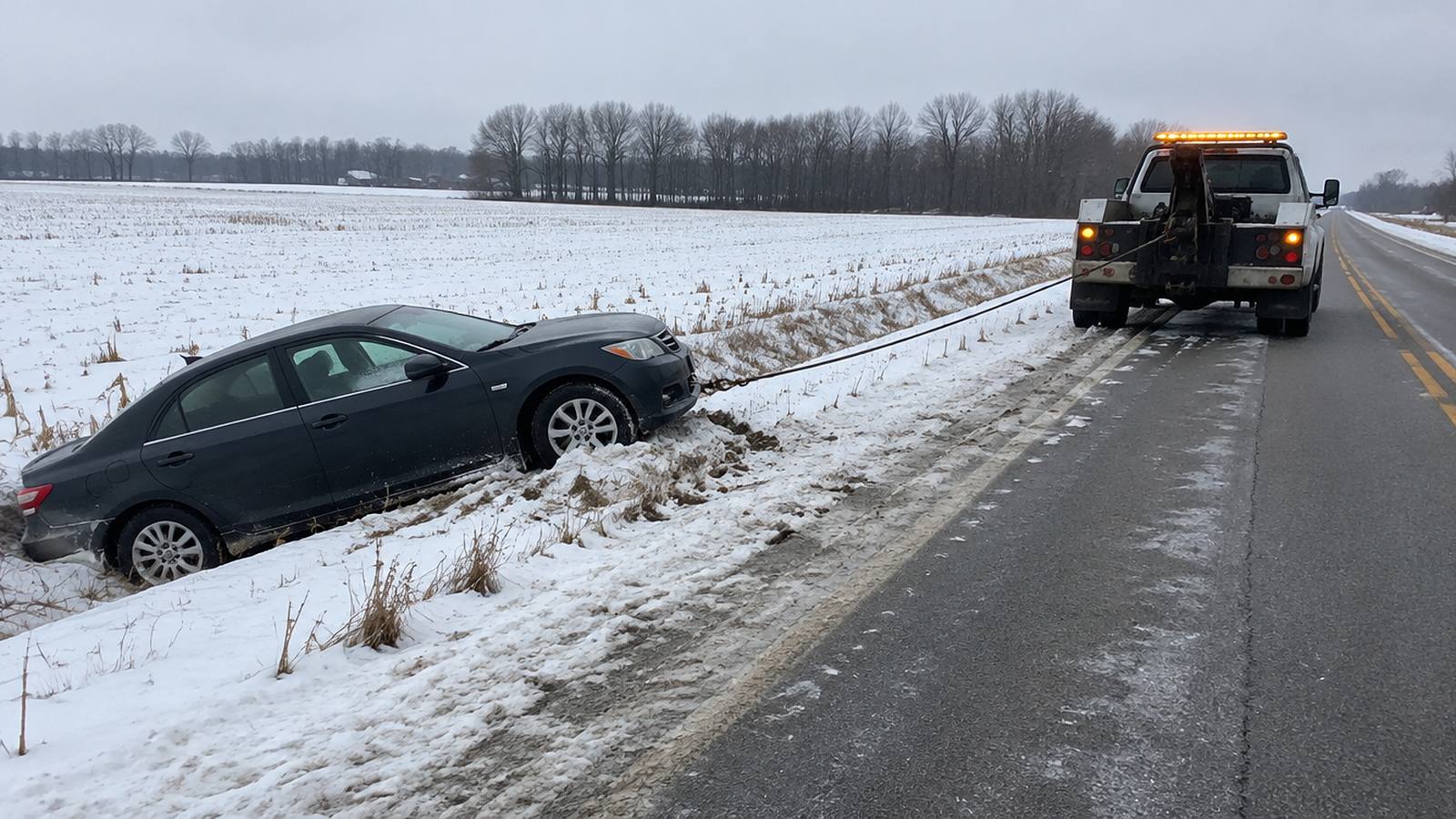
Winch-Out and Recovery in Shelby Township, MI
A car, pickup, van or SUV stuck in a snowbank, a ditch, gravel-road mud or on an icy driveway goes back onto firm ground on our winch line. Light-duty vehicles only, priced on the phone first.
Stuck in snow, mud or a ditch? Get safe first, then give us four details
Shelby Township Towing pulls light-duty vehicles out of snowbanks, roadside ditches, muddy gravel roads and icy driveways at any hour. If any part of your car is in a traffic lane, or anyone is hurt, call 911 before you call us: only the police can hold traffic back.
Off the road and unhurt? Michigan's Office of Highway Safety Planning advises staying with the car unless a safe place is in sight, and not wearing yourself out digging. Keep the exhaust pipe clear, run the engine 5 to 10 minutes an hour with a window cracked, and leave the hazards on; after dark, headlights off and dome light on.
Then stop spinning the tires: more wheelspin packs snow into ice or digs deeper into mud. And don't let a passer-by yank on a strap tied to your bumper. Wait for the winch.
When you call, tell us:
- What's holding it. Snowbank, ditch, mud, ice or a soft shoulder, and how deep the tires sank.
- Distance to pavement. One wheel off the edge is a short pull; a car down a slope or in a field needs more line.
- How it's sitting. Nose-first, backed in, sideways or tilted, and whether it's still on all four wheels.
- The exact spot. The mile road and nearest cross road, the street, your driveway, or the freeway, direction and last exit.
On the shoulder, our amber lights put the truck under MCL 257.653a, Michigan's move-over law: passing drivers must slow to at least 10 mph below the posted limit and move a lane over where they can. Plenty don't, so wait well away from the road.
How a winch-out is priced: the pull, the rigging, the time and what happens after
Snow, mud and ditch banks each let go differently, so a recovery takes more questions than an ordinary tow. You still get one total on the call, before a truck leaves, built from these parts:
- The pull. How deep the vehicle sits, in what, and how far from pavement our truck can stand on.
- The rigging. One line to a recovery point is quick; a snatch block, extra straps or digging packed snow from under the frame takes longer.
- Time on scene. Pulling in short stages and checking the car between them is slow work, and we size it up closely on the phone.
- After it's out. Many cars drive off. If yours can't, or it's AWD, 4WD or electric and won't run, it goes home or to a shop on our flatbed, in the same total.
Our pricing page covers what moves a recovery or tow price up or down, including what changes when police order the tow.
Every truck we run is light-duty, sized for cars, pickups, vans, SUVs and motorcycles. We don't recover RVs, semis, buses, tractors or other farm machinery, construction equipment, box trucks, or trailers carrying a load. Those need a heavy-duty wrecker, and we'll tell you so on the call.
How we pull a vehicle out of a snowbank, a ditch, mud or an icy slope
Every recovery starts the same way: the truck parks on pavement or packed ground that will hold it, sets its brake and chocks, and runs the winch line out to your car. A truck that drove onto the same soft shoulder would only be a second stuck vehicle.
We hook only to a factory recovery point, a screw-in tow eye or soft straps around a wheel or frame member, never a bumper cover, a tie-down slot or a suspension arm. The pull is slow and steady, in short stages, with stops to check the angle.
A winch line under load stores a lot of energy; if a strap or hook lets go, it can whip back hard. During the pull, everyone stands well off to the side, away from both ends, until the driver says the line is slack.
Snowbanks and plow ridges
A car that slid into a snowbank often has packed snow under the frame, holding weight off the tires. We dig around the tires and under the front, then draw it back out the way it went in; a car high-centered on a plow ridge needs that snow cleared from underneath first.
Ditches and soft shoulders
With two wheels over the pavement edge, a short sideways pull brings the car back. Nose-down in a ditch, it comes out backward with the line angled a little upward, so the front end lifts clear of the bank; a snatch block fixes the angle when the truck can't line up. If water stands in the ditch, leave the engine off.
Mud on gravel and dirt roads
Mud holds a tire by suction, not just depth, so these pulls go slower. The truck keeps to the firmest stretch, which in a thaw can mean working from a paved crossroad with a long line out.
Icy driveways, hills and sloped lots
A car that slid down an icy driveway or a sloped lot is drawn back slowly to level ground, with the truck set where its own tires grip. The State Police's highway-safety office makes a point worth keeping: front-wheel, all-wheel and 4WD vehicles are just as hard to stop and turn on wintry roads as rear-wheel-drive ones.
Once it's on firm ground, we check underneath for packed snow and leaks, and make sure the wheels point straight and the steering turns. Then you drive away, or, if something is bent, it rides the flatbed.
Snow, gravel roads, parks and ice around Shelby Township, and the rules that limit a tow truck
How much snow, and who plows it
NOAA's 1991-2020 normals put December-through-February snowfall at 25.0 inches at the Mount Clemens air base and 29.2 inches at Pontiac, out of 32.2 and 36.0 inches a year. In the townships, the Macomb County Department of Roads plows state and primary roads first, waits for four inches before plowing subdivision roads, and salts subdivisions only at entrances, exits, intersections and hills, so mid-block can stay packed while the mile roads are bare.
Watch for black ice too: the State Police's highway-safety office says it forms on bridges, ramps and overpasses, after sudden temperature drops and in shade.
Gravel roads and the spring thaw
The county keeps about 335 miles of gravel roads across Macomb County and grades them as needed, weather permitting, with the program typically starting in May. Until then, the thaw rules: MDOT's spring weight limits exist because trapped moisture softens the roadbed, and a February 2026 news report on Oakland County's roughly 750 miles of gravel explained that partly frozen soil leaves meltwater nowhere to drain, so the road turns soft and every vehicle deepens the ruts.
On a rural road, give us the nearest crossroad and send a map pin from your phone if you can.
Parks, trails and frozen lakes
Stony Creek Metropark covers parts of Washington, Oakland and Shelby townships, and the Huron-Clinton Metroparks rules keep motor vehicles on designated park roads and parking spaces, ban off-road driving and open parks from daylight to 10 p.m. unless posted. Stuck inside Stony Creek? Call the park office at (586) 781-4242 as well as us.
Our trucks never go onto ice. Stony Creek allows ice fishing on the lake below 28 Mile, but the Michigan DNR says no inch-thickness reliably makes ice safe and that snow-covered ice should always be treated as unsafe. A vehicle on or through the ice is a 911 call.
Rail-trails are closed to motor vehicles too. The 24-mile Macomb Orchard Trail, from Dequindre and 24 Mile in Shelby Township past orchards, crop fields and dairy farms to Richmond, prohibits them, and so does the 8.9-mile Paint Creek Trail out of Rochester. We work from the road or a lot, never the trail; check with the trail's managers if a recovery would cross one.
Official pages to check before you go
- NWS Detroit/Pontiac winter forecasts - snow and ice forecasts for southeast Michigan.
- Stony Creek Metropark - park hours, winter activities and closure updates.
- Michigan DNR ice safety - how to judge ice, and what to do if you break through.
- Macomb Orchard Trail - the county's trail page, with closures and the contact for trail questions.
Winch-outs in the eight towns around Shelby Township
We pull cars out all over Shelby Township, the home base of our towing service, from subdivision streets off the mile roads to the shoulders of M-53, and in each town below. Every link opens that town's own winch-out section.
- Winch-outs in Utica - about 3 road miles south; Utica's streets fall under the city, not the county, and the Clinton River runs through the center of town.
- Winch-outs in Sterling Heights - about 8 road miles south; the Clinton River crosses the northeast part of the city, and each crossing is a bridge, one of the spots where the State Police's highway-safety office warns black ice forms.
- Winch-outs in Macomb Township - about 6 road miles east; as in every Macomb County township, subdivision roads are county roads, so the four-inch plowing rule applies.
- Winch-outs in Washington Township - about 6 road miles north; a green street sign means a public road the county maintains, a blue one a private road maintained at private expense.
- Winch-outs in Romeo - about 12 road miles north; the Macomb Orchard Trail runs through the village, closed to motor vehicles, and north of town M-53 narrows to a rural two-lane highway near 34 Mile.
- Winch-outs in Rochester - about 6 road miles; under the city's 2016 winter program, a storm over six inches can bring a snow emergency with parking restrictions, and Main Street's snow is windrowed to the center.
- Winch-outs in Rochester Hills - about 7 road miles; named partly for its rolling hills, the city climbs from 690 feet in the southeast to 1,032 feet in the northwest.
- Winch-outs in Clinton Township - about 12 road miles southeast; the township says it has no jurisdiction over its roads, so report an unplowed or rutted street to the Macomb County Department of Roads at 586-463-8671.
Frequently asked questions
Can you pull my car out of a snowbank or a ditch in Shelby Township?
Yes. Shelby Township Towing winches cars, pickups, vans, SUVs and motorcycles out of snowbanks, roadside ditches, muddy gravel roads and icy driveways at any hour. Our truck stays on firm ground, the line goes to a proper recovery point and the pull is slow. If the car is in a traffic lane or anyone is hurt, call 911 first, then us.
Should I keep rocking the car to get it unstuck?
One gentle try is fine; after that, stop. More wheelspin packs snow into ice or digs deeper into mud, and a strap tied to a bumper can tear parts off. Michigan's highway-safety office also warns against wearing yourself out digging. Keep the exhaust pipe clear, run the engine in short spells with a window cracked, and wait for the winch.
Will a winch-out damage my car?
It shouldn't when it's rigged properly. We attach only to a factory recovery point, a screw-in tow eye or soft straps around a wheel or frame member, never a bumper cover or a suspension arm, and we pull slowly in stages. Once it's out, we check the steering, the wheels and the underside; if something is bent, the car rides the flatbed.
My car is stuck on a muddy gravel road in spring. Can your truck reach it?
We can if there is firm ground within reach of our winch line. In a thaw, gravel roads go soft because the partly frozen soil underneath can't drain the meltwater, so our truck works from the firmest stretch or a paved crossroad. If your car is too far from solid footing for a light-duty truck, we'll tell you on the call.
Do you pull out tractors, RVs or loaded trailers?
No. We run light-duty trucks for cars, pickups, vans, SUVs and motorcycles. RVs, semis, buses, tractors and other farm machinery, construction equipment, box trucks and loaded trailers need a heavy-duty wrecker. Tell us what's stuck when you call; if a light-duty truck can't pull it safely, you'll hear that right away.
My car went off the road in a park or onto a frozen lake. Can you get it?
Inside a Metropark, vehicles belong only on designated park roads and in designated parking spaces, so call the park office as well as us and follow its directions. We never drive onto ice; the Michigan DNR says no inch-thickness reliably makes ice safe. A vehicle on the ice or through it is a 911 call first.
Tell us how it's stuck, and we'll quote the pull before we roll
One total, given on the call, covers the pull and any tow afterward.
- What it's in - snowbank, ditch, mud, ice or a soft shoulder, and how deep
- How far from pavement - one wheel over the edge, or down a slope or out in a field
- Your vehicle - make and model, and whether it drives two wheels or four, or runs on a battery
- Where you are - the nearest mile road and crossroad, a street name, or the freeway, direction and last exit