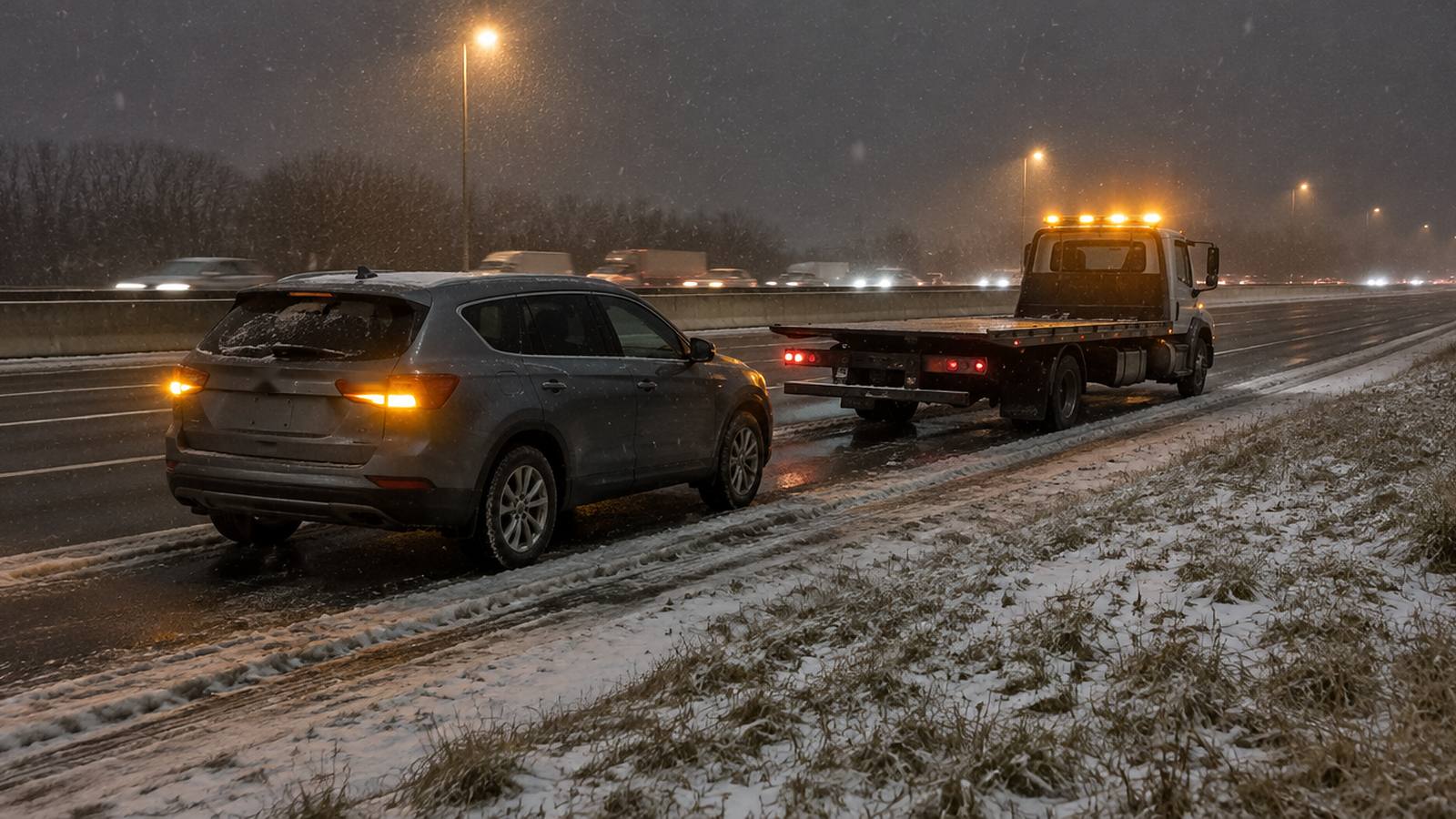
Emergency Towing in Shelby Township, MI
Get safe first, then call: give us the M-53 exit or the nearest mile road and cross street, and you'll hear one total price before a light-duty truck rolls.
After a crash or breakdown: get safe, call, then answer four questions
If anyone is hurt, or your car is stopped in a live lane of M-53, Hall Road or a mile road, call 911 first. Once everyone is out of danger, call Shelby Township Towing - the phone is answered day and night, every day of the week.
Michigan expects you to clear the road when you safely can. Under MCL 257.618a, a driver in a crash must move the car out of the main traveled lanes - to the shoulder, the median or off the road - when that can be done safely and the car still drives normally. The duty doesn't apply if you know or should know someone was seriously injured, and moving the car doesn't by itself make you the one at fault.
While you wait
- Stuck in a lane? Hazards on, then 911. If the car can't move and there's a safe way out on the side away from traffic, the State Police say to get clear and wait off the road; when there isn't, keep your belt on and stay put.
- On the shoulder? Hazards on. If you get out, use the door away from traffic and wait well back from the pavement, behind a guardrail if there is one.
- Hit a deer? The State Police advice: flashers on, seat belt on, move to the shoulder if you can, and call the police to report it.
Once our truck stops behind you with its amber lights flashing, Michigan's move-over law protects it: approaching drivers must drop their speed at least 10 mph under the posted limit and, where two lanes run their way, move over a lane or two vehicle widths if they can. Tow trucks count because MCL 257.2 treats a road service vehicle with flashing red or amber lights as an emergency vehicle for that section. A car showing only its hazards isn't on that list, so keep well clear of traffic.
The four questions we ask
- Where are you? On M-53, the direction and last exit (17 is Hall Road, 20 is 23 Mile, 23 is 26 Mile). Elsewhere, the nearest mile road and cross street, and on a boulevard with Michigan lefts, your side of the median.
- What are you driving? Year, make and model, and whether it's all-wheel drive, four-wheel drive, electric, lowered or a motorcycle. That decides which truck comes.
- What happened? A crash, a no-start, a slide into a snowbank or a tire that came apart - and whether the car still rolls and steers.
- Where should it go? Home, your mechanic, a body shop or a dealer. If police order the car removed, it goes to a place of safekeeping under their order instead.
Then you hear one total, and the truck leaves only after you say yes. We won't quote an arrival time we can't keep on a snowy freeway, so keep your phone on and the line free.
One total on the phone: how an emergency tow is priced
Every emergency call ends with one price for the whole job, given before a truck leaves and built from your answers. Four things move it:
- The truck. A front-wheel-drive car with sound wheels can ride the wheel-lift; the flatbed deck takes all-wheel-drive SUVs, EVs, lowered and classic cars, and motorcycles.
- The miles. Our run out to you and the loaded run to the drop-off both count: a car in Utica sits about 3 road miles from central Shelby Township, one in Romeo or Clinton Township about 12 road miles from central Shelby Township.
- Time at the scene. A car that rolls up the deck loads quickly. One nosed into a snowbank that needs the winch line first, or a crash car with a wheel that won't turn, takes longer.
- The drop-off plan. Home tonight and the shop tomorrow is two trips. Straight to the shop's after-hours key drop is one.
There's no rate card on this site: two crash tows a mile apart can need different trucks and very different time on scene. A tow somebody else orders - an officer after a crash, or a lot owner clearing a private lot - isn't one you book with us, and the cost page explains who sets the fee when police or a property owner orders the tow.
If the trouble is smaller than a tow - a battery, or a flat with a good spare - we'll say so, and you can book a jump start or tire change at the roadside instead.
How we get a crashed or dead car onto the truck
Every truck we run is light-duty: cars, pickups, vans, SUVs and motorcycles. RVs, semis, buses, box trucks and loaded trailers need a heavy-duty operator, and we'll say so on the call.
Wheel-lift or flatbed
A wheel-lift raises one axle by its tires while the other rolls behind, which suits a front-wheel-drive car with healthy wheels. All-wheel and four-wheel drive vehicles, electric cars, lowered and classic cars and every motorcycle ride the flatbed even on a short trip; beyond the nearby towns, the flatbed carries every car. Our flatbed towing page explains why.
Loading, in order
- If you can do it safely, take a few photos of the car where it sits, so any crash damage is on record before it moves.
- The deck tilts down and the winch line draws the car up; a locked wheel rides a skate instead of dragging.
- Tie-down straps over the tires, or wheel nets, hold the car by its wheels, never by steering or brake parts.
- An EV goes into its transport or tow mode first, and a car stuck in park may need the shift-lock override, so leave us the key or fob.
A car in a ditch or a snowbank comes out on the winch first - our winch-out and recovery work, done on the same call. Before we pull away, grab your wallet, charger, medicine, house keys and any child seat; a crash car may sit at a shop for days.
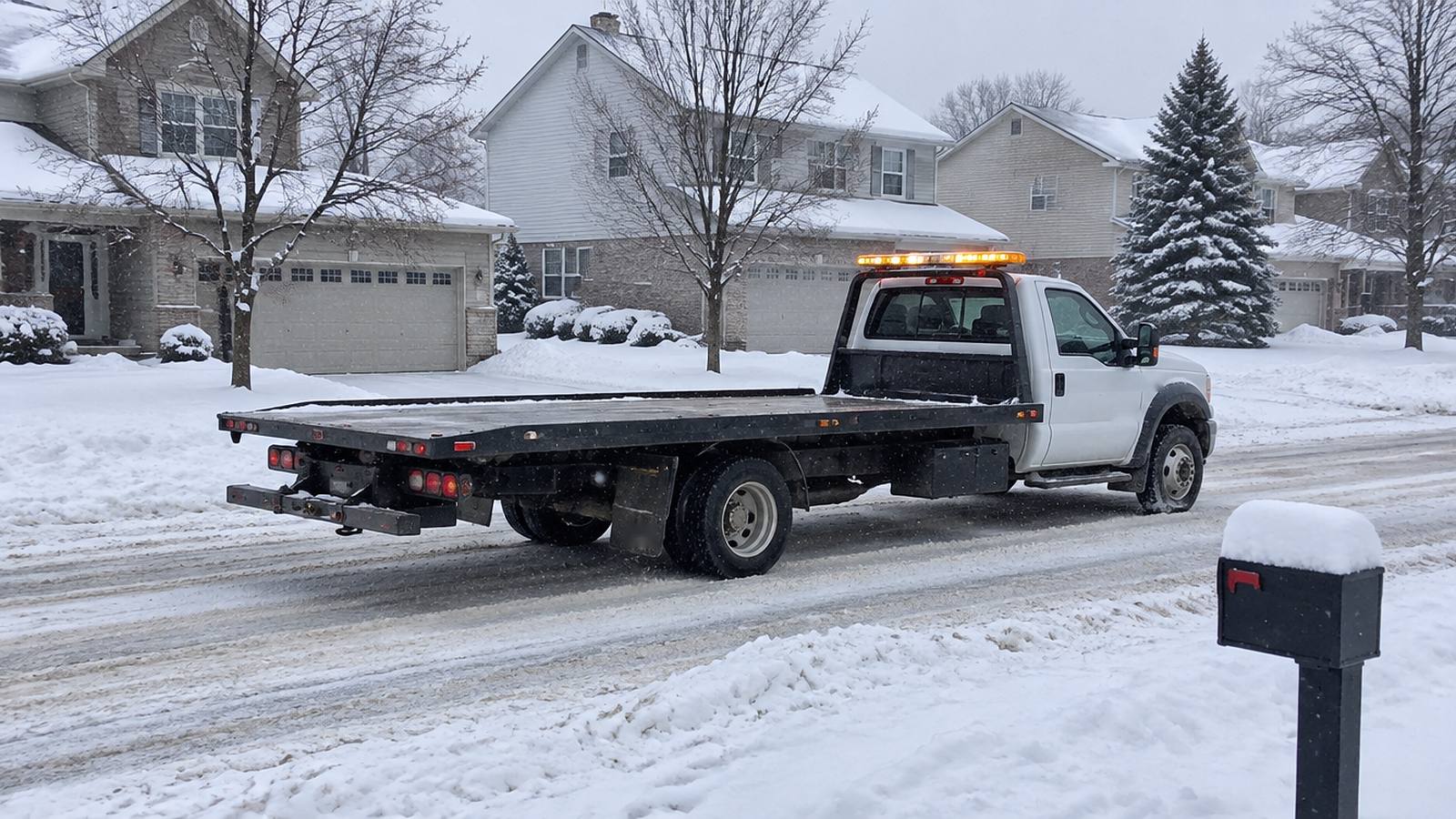
M-53, Hall Road, the mile roads and who answers the call
M-53, the Van Dyke Freeway, passes the east side of Utica in Shelby Township; the freeway begins near 18 Mile in Sterling Heights and ends at exit 25 in Washington Township, becoming an expressway with cross-street intersections. M-59 runs as a freeway through Rochester Hills, passes Dequindre Road at the Oakland-Macomb county line and ends at Van Dyke Avenue in Utica, where it becomes Hall Road.
The mile roads count north from Detroit, and Hall Road is 20 Mile. In Oakland County the same lines carry other names - 23 Mile is Avon Road, 24 Mile is Walton Boulevard, 25 Mile is Tienken Road - so once you've crossed Dequindre, give us the Oakland name. Shelby Township has no road jurisdiction of its own: the township's roads page says MDOT maintains the M-53 expressway, the Macomb County Department of Roads handles the other maintenance and snow removal, and the Road Commission for Oakland County maintains Dequindre.
Who answers a 911 call
Dispatch sends whichever agency covers the spot: the Shelby Township Police Department in the township, Sterling Heights' own police, Macomb County Sheriff's deputies under contract in Macomb and Washington townships, and the Oakland County Sheriff's Office in Rochester Hills, which has no police department. State troopers come from the Michigan State Police Metro North Post, whose territory takes in both Macomb and Oakland counties.
- Injury, fire or a car stopped in a live lane
- Call 911
- Shelby Township Police, non-emergency
- (586) 731-2121
- State Police Metro North Post (Macomb and Oakland counties)
- 248-584-5740
If police come, they write the crash report, the UD-10. The State Police say you buy it online through the state's Traffic Crash Purchasing System, usually 3 to 30 days later, depending on the agency.
How long a stuck car can stay put
Not long. Police can order a car removed at once when it's an immediate hazard, blocks traffic or can't be driven safely from a crash (MCL 257.252d), and in a snow emergency or storm they can clear cars for public safety. Under MCL 257.252a, a car left on a state trunk line highway such as M-53 or Hall Road counts as abandoned after 18 hours if it has a valid plate; on other public property it's 48 hours.
Snow and deer
Plan on snow from December into March: the National Weather Service's 1991-2020 normals for Detroit list 8.9 inches in December, 14.0 in January, 12.5 in February and 6.2 in March, with an average January low of 19.2°F. Before you set out, MDOT's Mi Drive map shows crashes, closures, traffic cameras, live speeds and where MDOT's own plows are working.
Michigan Traffic Crash Facts counted 702 vehicle-deer crashes in Macomb County and 2,024 in Oakland County in 2024, with November and October the worst months statewide. The State Police say deer move most at dawn and dusk and about 80 percent of deer crashes are on two-lane roads. Their rule: don't swerve - brake firmly and stay in your lane.
Emergency towing in Utica, Sterling Heights, Romeo and five more towns
Each town page has an emergency section with its own roads, interchanges and police agency. Choose yours, or go back to towing across Shelby Township.
- Emergency towing in Utica - M-59 runs along the city's southern border and M-53 crosses its east side; they meet at exit 17, the Hall Road exit, on the Utica-Sterling Heights line.
- Emergency towing in Sterling Heights - east-west traffic rides the mile roads from 14 to 20 Mile, and the Sterling Heights Police Department is the city's main law enforcement agency.
- Emergency towing in Macomb Township - Macomb County Sheriff's deputies patrol the township under contract from a local substation, and Macomb Corners sits at Romeo Plank Road and 25 Mile.
- Emergency towing in Washington Township - Sheriff's deputies patrol the township by contract, and M-53 crosses in from Shelby Township at exit 23, 26 Mile, on the township line.
- Emergency towing in Romeo - the M-53 expressway skirts the village to the east, where 30 Mile and 32 Mile cross at grade and 32 Mile leads into downtown at Main Street.
- Emergency towing in Rochester - Rochester Road, M-150, forms one of downtown's main streets and crosses the Clinton River north of Avon Road.
- Emergency towing in Rochester Hills - with no police department of its own, the city is covered by the Oakland County Sheriff's Office, and its east edge, Dequindre Road, is the Shelby Township line.
- Emergency towing in Clinton Township - Michigan's most populous township wraps around three sides of Mount Clemens, and Gratiot Avenue (M-3) runs through its Broad Acres area between 15 Mile and Quinn Road.
Official pages to bookmark
- Michigan State Police: vehicle-deer crashes - what to do before and after a deer strike, and the months deer move most.
- National Weather Service Detroit/Pontiac climate normals - month-by-month snow, rain and temperatures for Detroit, Flint and Saginaw.
Frequently asked questions
Do you handle emergency towing in Shelby Township at 2 a.m. or on a holiday?
Yes. Our phone is staffed around the clock, holidays and weekends included, and the truck that goes out handles cars, pickups, vans, SUVs and motorcycles. Give us the location, the vehicle, the problem and the drop-off, and you hear one total for the tow before anything moves. We won't promise an arrival minute; the driver calls as the truck gets close.
I had a fender bender on M-53 and nobody's hurt - do I have to move my car?
If it drives normally and you can do it safely, yes. Michigan's MCL 257.618a says a driver in a crash must move the car out of the main traveled lanes to the shoulder, median or off the road. The duty doesn't apply if you know or should know someone was seriously hurt, and moving doesn't by itself put the fault on you. If it won't drive, switch on the hazards and call 911, and leave the car to wait off the road only when you have a safe way out that keeps you clear of traffic.
Do drivers have to slow down and move over for your tow truck?
Yes. Michigan's move-over law, MCL 257.653a, covers a stopped tow truck with its amber lights flashing, because the Vehicle Code counts a road service vehicle with red or amber lights as an emergency vehicle for that section. Passing drivers have to cut their speed by 10 mph or more below the posted limit and change lanes when they can. Your car with only its hazards on isn't covered.
I hit a deer on a two-lane road - do I call you or the police first?
Call the police to report it, as the Michigan State Police advise, then call us if the car shouldn't be driven. First, turn on your flashers, stay buckled and move to the shoulder if you can. A deer strike can crush a radiator or knock out a headlight, and driving on with either is a gamble; we can take the car home or to your shop.
How long can I leave my broken-down car on the shoulder of M-53?
Not long. Under MCL 257.252a, a car on a state trunk line highway such as M-53 or Hall Road counts as abandoned after 18 hours if it has a valid plate, and police can order it removed at once if it's a hazard or blocks traffic. Calling for a tow before you walk away keeps the destination your choice rather than an officer's.
Stuck on M-53 or a mile road? Have these four answers ready
They get you a firm price and the right truck on the first call.
- The spot - M-53 direction and last exit, or the nearest mile road and cross street
- The car - model year, make and model, plus the drivetrain, and if it's electric, lowered or a motorcycle
- What happened - crash, no-start, slide-off or a blown tire, and whether it still rolls
- The drop-off - home, your mechanic, a body shop or a dealer